Showing posts with label word problems. Show all posts

Wednesday, April 27, 2016

Curriculum Issues

I taught for two years with no centralized curriculum or standards-aligned textbooks to use. While many veteran teachers might love this amount of freedom, it was terrifying for a new teacher. I was able to make it work by focusing on the standards and pulling resources from multiple sources to create something usable for my students, but finally found a free curriculum to use my third year in the form of EngageNY. While it was not the end all be all answer, it was a wonderful place for me to start. Because I'd focused so heavily on my state's standards, I was able to modify lessons and units within EngageNY to fit those standards as well as meet the levels of my students and my own teaching style.

I highly recommend finding some sort of curriculum to use as a foundation for your lesson planning. I say this with a word of warning, however. Textbook and curriculum publishers have been notorious for placing whatever sticker they need to on the cover of their publication and selling it to states. This means that just because it says "Common Core Aligned," or "TEKS Aligned," etc., does not necessarily mean it is. [You can check out EdReports for an independent review of educational materials.]

Even if it is properly aligned, often the material isn't rigorous enough to be used without any modifications. Sometimes the questions are posed as "higher order thinking questions," but provide too much information to the students, and end up being a simple substitution problem. Other times, it is marked as a "modeling problem," but, again, all of the information is provided for the students. Here is a great example from Dan Meyer's blog:


Mathematical modeling is defined in similar terms by the Common Core State Standards, the modeling cycle, or the IB:

  1. identifying variables in the situation and selecting those that represent essential features,
  2. formulating a model by creating and selecting geometric, graphical, tabular, algebraic, or statistical representations that describe relationships between the variables,
  3. analyzing and performing operations on these relationships to draw conclusions,
  4. interpreting the results of the mathematics in terms of the original situation,
  5. validating the conclusions by comparing them with the situation, and then either improving the model or, if it is acceptable,
  6. reporting on the conclusions and the reasoning behind them.

In the above problem:
  • Who is identifying essential variables? Where?
  • Who is formulating the model for those variables? Where?
  • Etc.
Additionally, many teachers have not been properly trained on the new standards many of their states have adopted, or been given proper time to review and discuss the changes to the standards, and that leads to strange questions being asked, especially in math. For example:

This does not have to be the awful question it appears to be. This is asking students to decompose numbers and then regroup. For example, the student can rewrite the problem to be 8+2+3, which would result in 10+3. Or the student can rewrite the problem to be 3+5+5, which would result in 3+10. This is a bad question because of how it's asked, but not because of the underlying math the problem is trying to get at.

The standards are not a curriculum. They are standards students are expected to meet to help to close achievement gaps and prepare them for college and the workforce. The way teachers (or schools or districts) put in place curriculum and meet those standards is entirely their own, so there is no such thing as a "Common Core math problem," just like there is no such thing as a "TEKS math problem."

It is our job to make sure the questions we're asking our students align to the standards of our states and help our students master the skills outlined in those standards. If the textbook or curriculum we have been directed to use (or have chosen to use) does not meet that criteria, it is our job to modify when necessary.

What challenges have you faced with your curriculum?

Wednesday, April 13, 2016

The Problem with Key Words

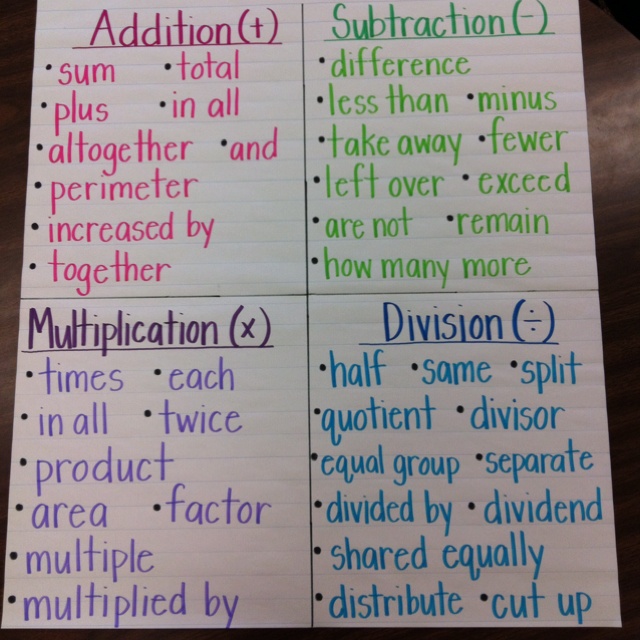
Key words are taught in math classes around the country. Teachers have anchor charts posted around the room with "helpful" reminders that "in all" means to add and that "left" indicates you should subtract. This method has been reinforced by the overly simple and formulaic story problems (word problems for those of us who are old school) often found in textbooks. We often present the key word approach to problem solving with good intentions. We want our students to know when certain operations should be used, and we think the best way to help them understand is to provide words that are linked to those operations. In theory, this works. In practice, however, we quickly realize there are limitations to the magic of key words.

When students rely on key words, they cease to reason about or understand the situation posed within the story problem. The key word approach encourages children to ignore the meaning and structure of the problem and look for an easy way out. This is why our students end up using the incorrect operations and are inconsistent with their mastery of solving word problems. In short, key words are the bane of my teachering experience.

Let's examine a story problem together.

I had 5 apples in my basket on Monday. On Tuesday I increased the amount of apples so now I have 7 altogether. How many apples did I add on Tuesday?

If the student is using the key-word approach, "increased," "altogether," and "add" would indicate they need to add 5 and 7 together to get 12 apples. The key words here are misleading, and will not help our students understand or solve this problem.

So how do we approach story problems if key words are not the answer? Building models is an excellent alternative! These can be physical models built with manipulatives or graphics that the students draw.

The example to the right is a bar model, and can be created with strips of paper or drawn as it is here. By comparing the part (the 5 apples I have on Monday) to the whole (the 7 apples I now have on Tuesday) I understand I am adding onto 5 until I get to 7.

The example below models the same problem, but uses manipulatives instead. We start with 5 apples, add some amount, and end up with 7 apples. From there, we can determine the number of apples needed to complete the problem.


Both of these methods allow students to start making connections between addition and subtraction and they can start to see how they are the inverses of each other. Both of these examples also help lay the foundation for Algebra later on, and both methods can be extended to help students understand multiplication and division and the relationship they have to one another. This is something that simply using key words does not help our students understand.

Here are some questions that you can use in whole class discussions or have students answer on paper. Similar questions can be used for most problems:

  • What is happening in this problem?
  • What will the answer tell us?
  • Do you think it will be a big number or a small number?
  • What operation do you think you'll need to use to solve this problem? Why?
Requiring students to provide an explanation of their process is also important. The explanation can be an illustration or written sentences. If students choose to draw pictures, make sure you have a discussion with them about what makes a good drawing in mathematics: simple is good. While we want to encourage our students to be artistic, we do not want our students to lose sight of the mathematics they are trying to model.


How do you approach teaching word problems in your classroom? What has your experience been with your students using key words?